In late 2023, I was trapped on what I call the "vibes treadmill."
Every Monday morning, I sat at my kitchen table with an empty coffee mug, staring at an empty Notion document. I spent two hours scrolling TikTok and X, waiting for divine inspiration to strike.
If I saw a funny meme about software bugs, I made a meme. If a trending audio was circulating with a sped-up synth track, I danced awkwardly in front of a ring light.
Some weeks, a video got 100,000 views. I felt like a genius. The following week, my next three uploads barely crossed 600 views. I had zero consistency, zero predictable revenue, and severe Sunday evening dread about what to create next.
That is how 95% of creators operate. They treat content like an art project governed by whimsical social algorithms.
The creators who quietly cross 100,000 followers and build million-dollar businesses treat content like an engineering feedback loop. They don't guess. They extract insights from audience data, detect statistical outliers in their niche, and compound winning formulas.
Here is the exact creator data framework that replaced my creative anxiety with predictable growth.
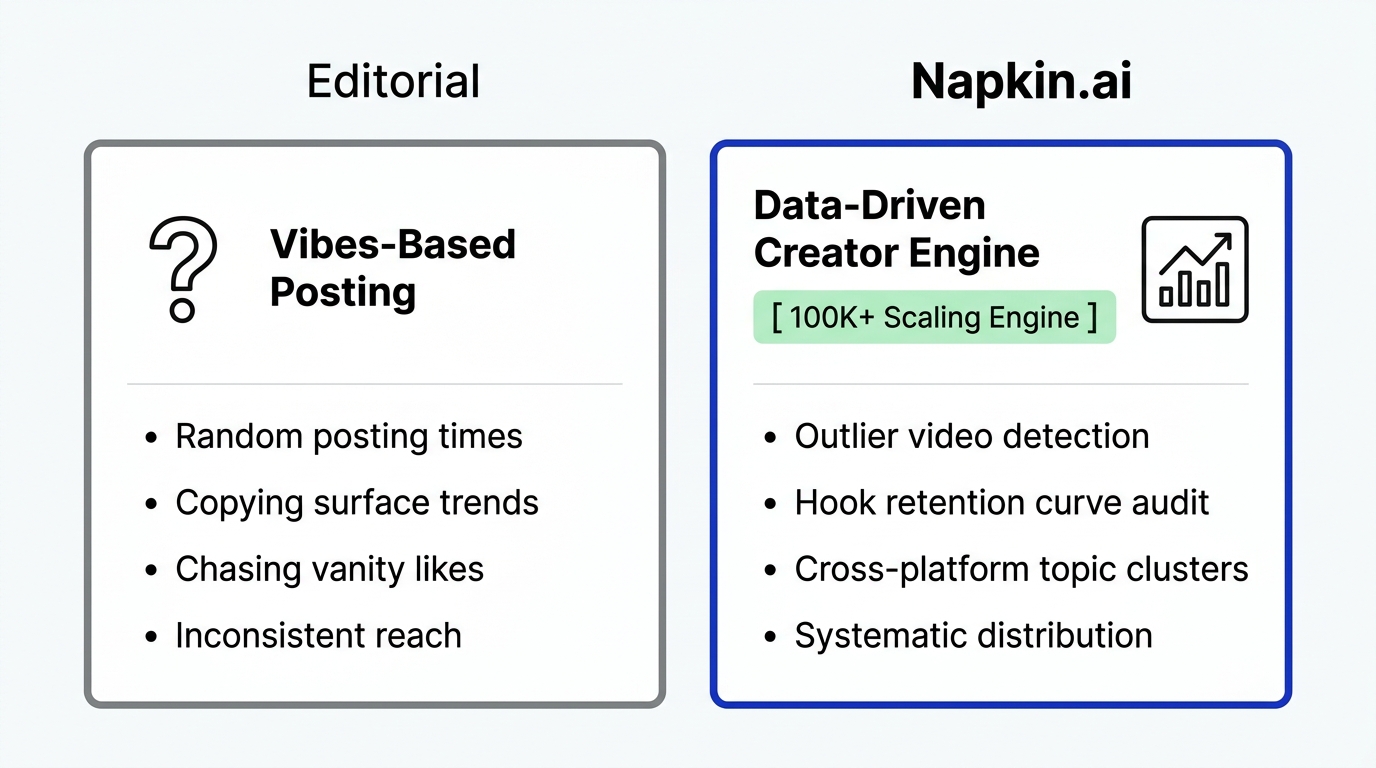
Vibes-Based Posting vs. Data-Driven Content Engineering
To understand why random posting fails, look at the fundamental difference between how amateur creators and full-time media brands operate:
| Operational Dimension | Vibes-Based Posting (The Amateur Trap) | Data-Driven Content Engineering |
|---|---|---|
| Ideation Source | Random scrolling, shower thoughts, whatever feels fun in the moment | Historical outlier analysis, search intent spikes, competitor comment teardowns |
| Scripting Cadence | Winging it on camera, rambling intros, unedited stream of consciousness | Pre-tested hook structures, rapid 3-second premise delivery, calibrated retention pacing |
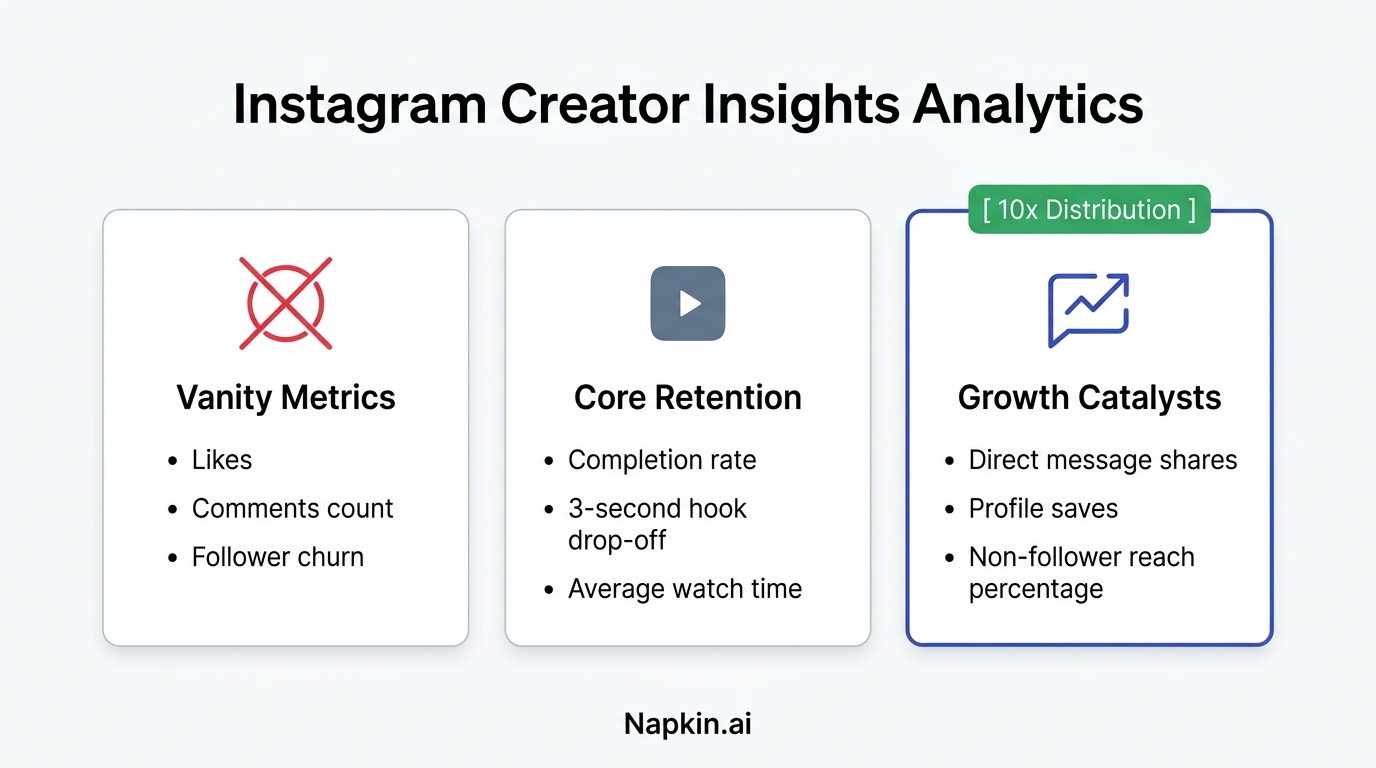
| Performance Review | Checking likes every 10 minutes on phone, getting emotional over low views | Weekly batch review of completion rates, DM share ratios, and subscriber velocity |
| Repurposing Plan | Uploading once to one app, letting the video die after 24 hours | Dispatched across 6 platforms with adapted aspect ratios and native platform hooks |
| Burnout Risk | Extremely high (dependent on continuous creative inspiration) | Low (systematized pipelines where winning formats are recycled regularly) |
Pillar 1: Finding Outlier Formats Before Writing a Word
The biggest mistake creators make is trying to reinvent storytelling on every upload.
Every niche on the internet already has proven formats that audiences love. Your job is not to invent a brand new video structure from scratch. Your job is to find what already works and bring your unique perspective, voice, and experience to it.
Here is how to spot outlier formats:
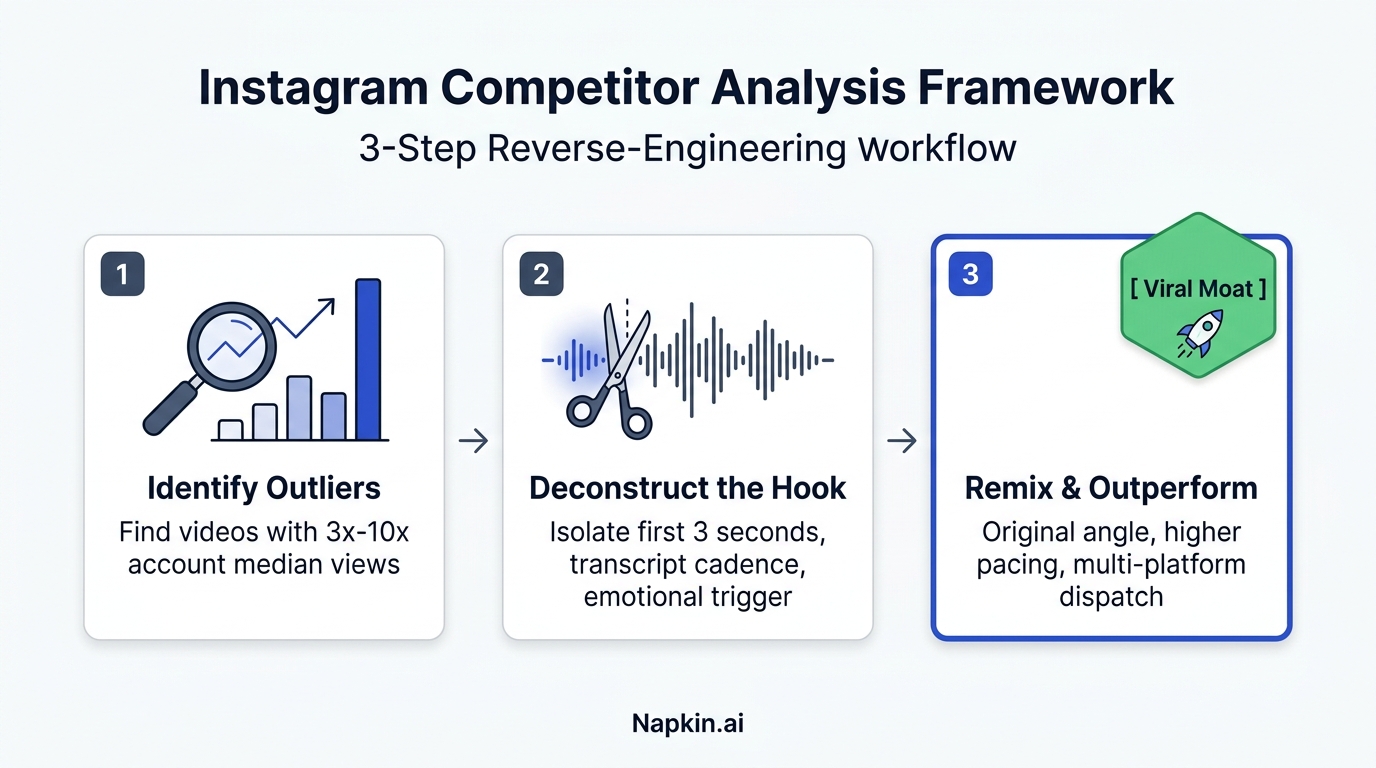
- Identify 10 creator accounts in your specific niche that have between 20k and 200k followers.
- Calculate each creator's median view count over their last thirty uploads.
- Look for the "spikes": videos that hit 5x to 10x their median views.
- Watch those spike videos on mute.
Why watch on mute? Because when you turn off the audio, you see the visual pacing:
- How fast did the text appear on screen?
- Did they start with an unexpected physical action?
- How many seconds passed before the first cut?
You can track these outlier patterns manually with a spreadsheet, or automatically scan your competitor landscape using the Creator Insights Competitor Tracking Engine.
Pillar 2: The Three-Second Retention Anchor
Data proves that people do not drop off gradually in short-form video. They drop off like a rock in the first two seconds, or they stay until the end.
When you analyze creator insights across thousands of short-form videos, retention curves always reveal the same pattern:
[ Second 0 to 2 ]:  Viewer decides whether to stop scrolling. 60% of people swipe away here.
[ Second 2 to 15 ]: Core argument or story delivery. Drop-off flattens to 5-10%.
[ Second 15 to 30 ]: The payoff or solution. If they made it here, they will view the CTA.
If you fix your first three seconds, you fix 80% of your view count issues.
The Three Hook Archetypes That Stop The Thumb
-
The Specific Negative (Fear of Loss):
"The reason your DaVinci exports look washed out on iPhone isn't your color grade. It's this one checkbox."
(Specific, solves a painful known problem, immediate curiosity.) -
The Direct Visual Proof (Show, Don't Tell):
Start with the finished result or the broken error message on screen before saying a single word. Let the visual create the question in their mind. -
The Counter-Intuitive Claim:
"Posting every day is the fastest way to kill your reach on LinkedIn in 2026."
(Challenges common advice, forces the viewer to listen for your reasoning.)
If you struggle to write hooks that hold attention, draft three variations for every video idea before filming. Test which premise sounds punchiest when spoken out loud. You can also generate high-retention frameworks with our AI Script Generator.
Pillar 3: Multi-Platform Topic Clustering
When you discover an outlier topic that your audience loves, never treat it as a one-and-done video.
A single proven topic can power two weeks of content across multiple channels:
                 [ The Core Winning Insight ]
                              |
       +----------------------+----------------------+
       |                                             |
[ Video Formats ]                             [ Written Formats ]
- 60s High-Pacing Reel                        - In-Depth Newsletter Deep Dive
- YouTube Shorts Case Study                   - Detailed X / Twitter Breakdown
- 10-Minute Long-Form YouTube                 - LinkedIn Carousel Slide Deck
For instance, when our post on Cross-Posting Video Quality Compression took off, we didn't just move to another topic. We adapted the color space technical breakdown into a LinkedIn technical teardown, an X thread with export presets, and a short YouTube tutorial demonstrating the settings live.
That single insight generated over 300,000 views across three networks from one hour of research.
Instead of burning yourself out writing fourteen disconnected ideas, build one deep topic cluster every week and distribute it everywhere with an integrated dispatcher like our Multi-Post Platform.
Your Weekly Data Review Routine
Block 30 minutes every Sunday afternoon for your creator audit.
Open your analytics dashboard on a desktop screen. Write down these four numbers:
- Median Views (Last 10 Posts)
- Top Outlier Multiplier (Best post divided by median)
- Average Non-Follower Reach %
- Top Shared Video of the Week
Pick your top-performing video. Ask yourself: Why did people share this with their friends?
Find that answer. Use it as the foundation for Monday morning's script. That is how compounding growth actually happens.