When I first started analyzing short-form video performance, I did what almost every creator does: I studied the biggest channels on the internet.
I bookmarked accounts with two million followers. I broke down their lighting setups, transcribed their intros, and tried copying their pacing.
And my videos completely flopped.
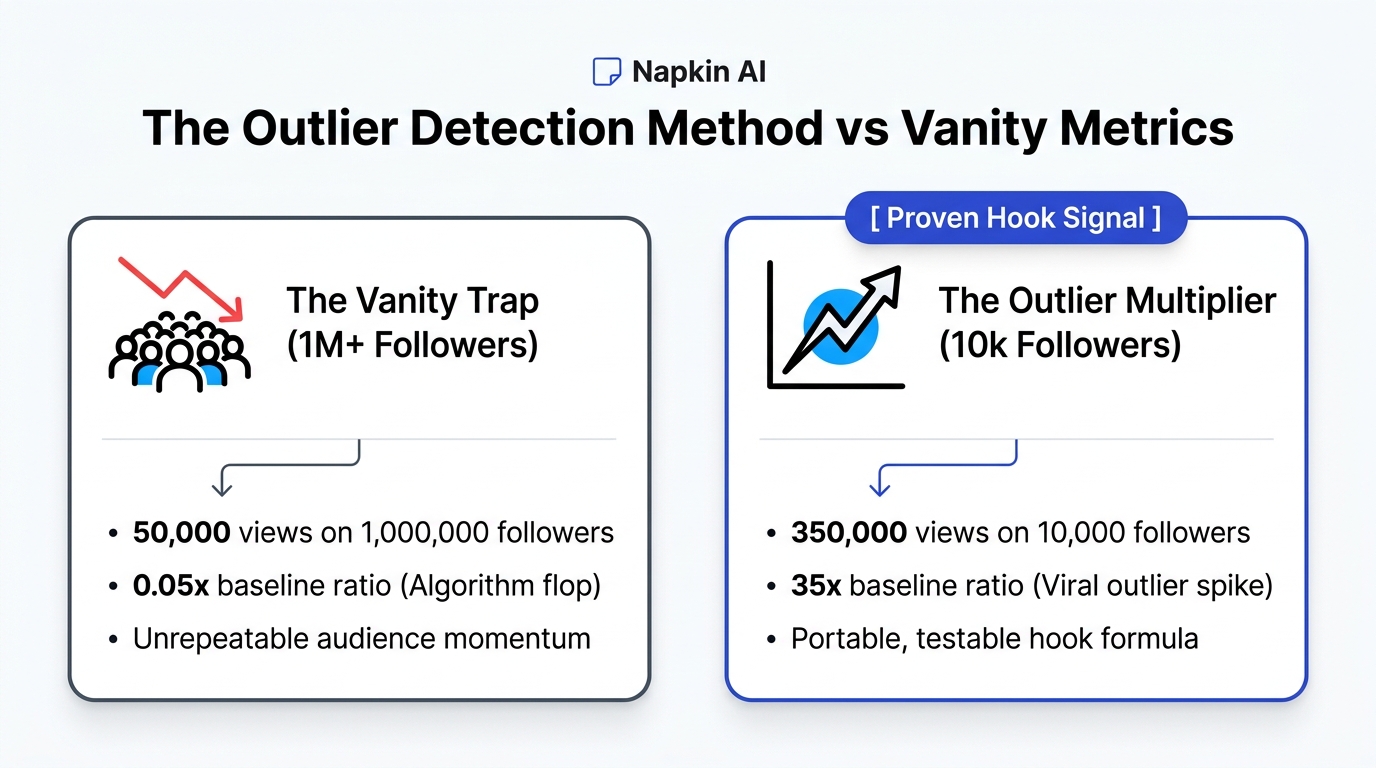
It took me months to realize why: large accounts have massive audience inertia. When an account with two million followers uploads a video, thirty thousand people watch it in the first twenty minutes simply because they like the person's face. The recommendation algorithm sees that instant retention burst and pushes the video onto the Explore page, even if the actual hook was mediocre.
Copying a mega-creator won't teach you how to make a viral video. It will only teach you what an established audience tolerates from someone they already trust.
If you want to find hooks and topics that genuinely work on cold audiences, you have to look for outliers on small accounts.
What Exactly Is an Outlier?
An outlier is a video that performs dramatically better than an account's typical baseline.
If a creator with 4,000 followers usually gets 1,200 views per Reel, but suddenly publishes a video that hits 350,000 views, that's an outlier.
The algorithm didn't push that video because of the creator's follower count. They barely had any. It pushed the video because the topic, the opening three seconds, and the structural tension of the script forced thousands of complete strangers to stop scrolling and watch until the end.
That small creator accidentally discovered a pocket of viral demand. And that is the exact blueprint you want to study.
| Account Type | Follower Count | Median 30-Day Views | Outlier Video Views | Outlier Multiplier | Why It Matters |
|---|---|---|---|---|---|
| Mega Account | 1,500,000 | 250,000 | 300,000 | 1.2x | Baseline noise. Audience inertia carried the views. |
| Mid-Tier Account | 80,000 | 15,000 | 45,000 | 3.0x | Decent topic resonance, but hard to isolate the hook. |
| Micro Account | 6,500 | 1,800 | 180,000 | 100x | Pure structural outlier. The hook cracked cold audience distribution. |
When an account gets 50x or 100x its typical baseline views, the concept has proven it can survive algorithmic cold testing.
The Outlier Multiplier Formula
To spot these videos systematically, you need to ignore raw view counts and look at the Outlier Multiplier:
Outlier Multiplier = Post View Count / Median View Count of Last 30 Videos
Always use the median, never the average. If a creator had one video hit 2 million views six months ago, using the average will artificially inflate their baseline and hide real trends. The median shows you their honest floor.
Here is how I grade outlier scores when scanning competitors:
- 1.0x to 1.9x: Regular baseline performance. Existing followers watched it; the algorithm didn't bother testing it on new feeds.
- 2.0x to 4.9x: Above-average interest. Good topic, but probably not a breakout format.
- 5.0x to 9.9x: Strong outlier. The opening hook broke through the first cold testing tier.
- 10.0x or higher: True viral breakout. This is gold. The topic, visual hook, or psychological trigger resonated across broad recommendation buckets.
The 4 Steps to Reverse-Engineer an Outlier
Finding an outlier is only half the battle. You can't just copy the other creator's video word for word; audiences sniff out copycats immediately, and platforms penalize duplicate audio and script matches.
The goal is to extract the structural skeleton and fill it with your own authentic expertise.
1. Transcribe the First 7 Seconds Word for Word
Listen to the opening of the outlier video and type out the exact script. Don't summarize it. Write down every single word, including the pauses.
Look at how the creator phrased the problem. Did they start with a question? Did they make a provocative claim? Did they state a dollar figure or a specific time limit?
In Creator Insights, you can paste any TikTok or Reel link into the Creator Canvas to extract the timestamped transcript instantly.
2. Spot the 3 Simultaneous Hook Layers
Every high-performing short-form video uses three hook layers working together in the first two seconds:
- The Spoken Audio: The opening sentence that breaks conventional wisdom (for example: "Stop putting your emergency fund in a high-yield savings account").
- The Visual Action: What the creator's hands or eyes are doing on screen to interrupt the viewer's mindless thumb-scroll.
- The On-Screen Text Banner: High-contrast text sitting in the upper third of the screen so silent scrollers immediately understand the topic.
Notice how all three layers point to the exact same idea at the exact same moment. If the video shows the creator walking while the audio talks about taxes and the text says "Check this out," the video dies at 1.5 seconds. Outliers achieve total alignment across all three channels.
3. Identify the Core Psychological Tension
Viral hooks usually tap into one of four basic emotional triggers:
- The Hidden Loss: Showing viewers they are losing money, time, or status without knowing it.
- The Counter-Intuitive Truth: Taking advice everyone agrees with and showing why it actually hurts people.
- The Asymmetric Hack: A simple shortcut that saves hours of effort or unlocks an unfair advantage.
- The Concrete Teardown: Analyzing a specific failure or success with real numbers instead of vague theories.
4. Swap in Your Own Domain Knowledge
Now take that exact structural container and pour your own real-world experience into it.
Suppose a fitness creator gets a 30x outlier with: "The three gym exercises that are completely destroying your lower back after age thirty."
If you are a software founder, you can adapt that structural syntax directly: "The three database queries that are quietly destroying your server performance after ten thousand users."
If you are a freelance designer, you can adapt it to: "The three contract clauses that are secretly costing you thousands on every client rebrand."
The hook structure holds the viewer's attention. Your real experience delivers the value.
Why Outlier Detection Beats Old-School Keyword Research
Traditional SEO keyword tools (like Ahrefs or SEMrush) tell you what people are actively searching for in Google search bars. That's great for writing long-form how-to articles, but it tells you very little about what works in algorithmic recommendation feeds.
In feeds like TikTok, Instagram Reels, and YouTube Shorts, nobody is searching for your video. The algorithm is pushing your video onto people's screens while they lie in bed.
| Discovery Method | Traditional Keyword Research | Outlier Tracking |
|---|---|---|
| Where it works | Google Search, YouTube Search, Pinterest | TikTok For You Page, Reels, Shorts Feed |
| User intent | Active searcher looking for a quick answer | Passive scroller wanting entertainment or insights |
| Who wins | High-domain-authority websites with 1,000 backlinks | Anyone with a clean 3-second hook and high retention |
| Testing speed | Takes 3 to 6 months to rank on page one | Takes 24 hours to see if an algorithm likes the video |
Don't abandon keyword research completely. Use search keywords for evergreen tutorials that you want people to find next year. But when you need to know what format will grab attention on short-form video this Thursday, outlier tracking is twenty times faster.
How I Run My Weekly Competitor Outlier Audit
I don't sit in a dark room trying to brainstorm video ideas out of thin air on Monday morning. I let the market tell me what audiences already want.
Here is my exact 30-minute weekly routine:
- Track 15 Micro-Accounts: In Creator Insights, I set up a surveillance cohort of fifteen creators in my niche who have between 5,000 and 40,000 followers.
- Filter by Outlier Score: Every Monday, I filter for any video published in the last seven days with an Outlier Multiplier above 5x.
- Save to Creator Canvas: I drop the top three outliers onto my visual canvas, pull their transcripts, and highlight the opening hook structure.
- Script 2 Adaptations: I take the two best hook structures, write my own original stories into them, and record them on Tuesday morning.
When you validate your concepts before you turn on the camera, your baseline view counts climb naturally. You stop guessing, you stop burning out, and you stop wondering why the algorithm ignores your content.
Frequently Asked Questions
Can I use the Outlier Method if I just created a brand-new account?
Yes, in fact it's the single best way to launch a fresh account. New accounts have zero audience trust, meaning your videos rely entirely on raw hook retention during initial cold testing. If your opening seconds use a proven outlier framework, your completion rate will pass the platform's initial distribution gate.
How many accounts should I track in my niche?
Fifteen to twenty-five accounts is the sweet spot. If you track too few, you won't spot enough 5x outliers each week. If you track more than thirty, you'll drown in too much content noise. Focus on micro-creators who post consistently and experiment with fresh formats.
What if nobody in my exact vertical is getting big outliers?
Look at adjacent verticals that speak to the same type of person. If you sell accounting software for freelancers, look at creators teaching freelance web design or freelance copywriting. The business problems and emotional triggers are virtually identical, so their hook formulas will translate seamlessly to your audience.