Here is the thing most creators miss: TikTok's search bar now processes more queries from people aged 18–34 than Bing does globally. That is not a thought experiment. That is where we are.
As of 2026, 65% of Gen Z users report turning to TikTok for search, and nearly 49% of all US consumers have used TikTok to find something specific. The platform built its reputation on passive discovery — you open the app, the algorithm feeds you content. But search on TikTok carries a completely different intent signal, and it rewards a completely different type of content.
If you are still writing captions for the For You Page and hoping search traffic follows, you are leaving a consistent, compounding source of views on the table.
Why People Search on TikTok Instead of Google
The honest answer is not that TikTok is better than Google. It is that TikTok answers a different kind of question faster.
When someone types "best sourdough starter routine" or "how to negotiate rent" into TikTok, they want a real person showing them — not 2,200 words of SEO-padded text with four affiliate links at the top. The visual proof matters. So does the comment section. A video with 400 comments arguing about technique tells you more than a blog post with five-star reviews from bots.
This is why TikTok search skews heavily toward:
- Product reviews and unboxings where trust matters
- Tutorial content where seeing beats reading
- Local recommendations (restaurants, gyms, services) where Google results feel generic
- Lifestyle and wellness advice where credibility comes from lived experience
Google still dominates for factual queries and anything requiring a long authoritative source. But for "show me how to do this" or "what does this actually look like," TikTok has carved out territory that Google has not recovered.
How TikTok's Search Algorithm Actually Works
TikTok does not rank pages. It ranks videos. And the signals it uses are fundamentally different from Google's PageRank model.
There are four indexing layers that determine whether your video surfaces in search results:
1. Speech-to-text transcription. TikTok transcribes spoken audio automatically. If you say the search phrase out loud, TikTok indexes it. Say it in the first two seconds and you signal relevance before the viewer can skip. Most creators have no idea this is happening.
2. OCR scanning on text overlays. The algorithm reads on-screen text using optical character recognition. A text overlay in the first three seconds that matches the search query gets indexed alongside the audio. This is why tutorials that put the exact topic in the upper third of the frame consistently outperform ones that bury it in a caption.
3. Caption semantics, not hashtag volume. Stuffing your caption with #fyp and #viral hurts search discoverability. TikTok's ranking system scores semantic relevance — the meaning of the caption — against the query. A two-sentence caption describing what the video covers in plain language outperforms twenty hashtags.
4. Engagement quality signals. Watch time percentage and saves are the two metrics that matter most for search ranking. A 90-second video where 70% of viewers watch to the end ranks significantly higher than a 15-second video with 50% completion on the same query. Saves signal that the information was worth keeping, which TikTok treats as a search-quality vote.
The FYP vs. Search Divide (And Why They Require Different Content)
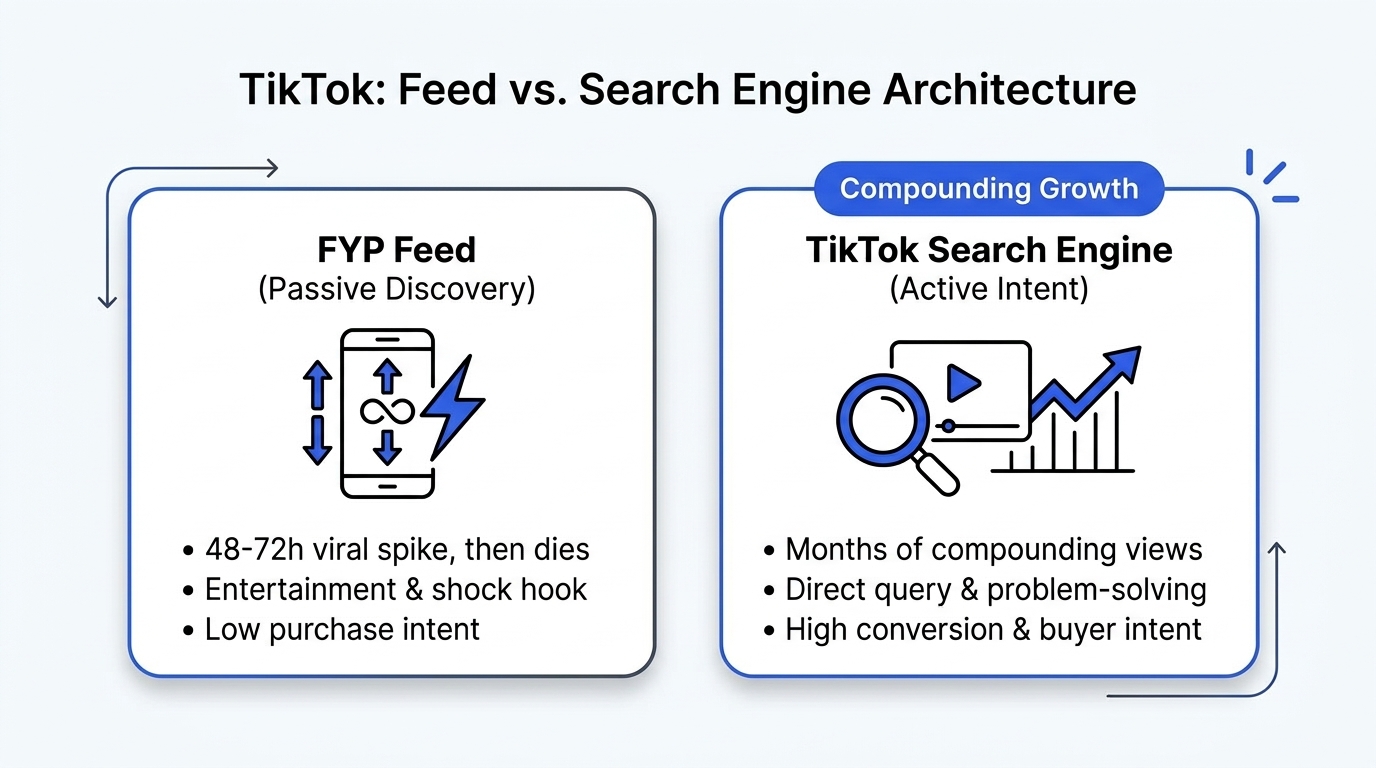
This is where most creators get tangled up. Content that goes viral on the For You Page is not the same content that ranks in TikTok search. The overlap exists, but they follow different rules.
FYP content rewards novelty, entertainment, and timing. An unexpected format or a reaction to trending audio can pull millions of views in 48 hours and then vanish. That traffic is real, but it does not compound. Next week, a different video gets the FYP lottery win.
Search content rewards relevance and retention. A well-structured video on "how to write a cold DM that gets replies" will keep pulling views six months after you post it, because the search query stays active. The video ages differently. Creators who build a library of search-optimized content end up with something that functions like a blog — traffic accumulates instead of spiking and disappearing.
| Signal | FYP Optimization | Search Optimization |
|---|---|---|
| Hook goal | Surprise / curiosity | Immediate topic clarity |
| Caption style | Trendy, emoji-forward | Semantic keyword phrase |
| Hashtag use | Trending sounds and tags | Topic-specific, minimal |
| Ideal length | 7–15 seconds for most niches | 45–90 seconds for tutorials |
| Traffic lifecycle | 48–72 hour spike | Weeks to months of steady views |
| Monetization signal | Passive intent | Commercial / purchase intent |
Creators who only optimize for FYP build follower counts. Creators who optimize for search build audiences who actually buy things.
What Content Gets TikTok Search Traffic in 2026
Based on what ranks consistently across niches, these formats drive the most reliable search volume:
Explicit answer videos. State the answer in the first sentence. "The reason your sourdough is not rising is because your starter temperature is wrong" gets indexed immediately. No slow intro, no asking the viewer to "stick around."
Comparison content. "X vs Y" queries are among the highest-volume on TikTok search. People searching for this are usually close to a decision. A 60-second breakdown of two products, tools, or approaches converts at a higher rate than almost any other format.
Structured tutorials. Step-by-step walkthroughs with clear on-screen text at each stage outperform general advice videos. Following along improves watch time and saves.
Local and niche specificity. "Best coffee in [City]" outperforms "Best coffee shops." The more specific the query, the lower the competition and the higher the purchase intent. TikTok search has not been saturated in most regional markets yet.
Myth-busting. "Actually, [common belief] is wrong" formats generate comments, which TikTok counts as an engagement quality signal. Debate in the comments extends a video's search longevity.
Why Brands Get This Wrong
Most brand accounts on TikTok treat the platform as a paid channel with organic decoration on the side. The content they post is polished, scripted, and completely disconnected from how real people search for things.
Nobody searches "innovative solutions for modern professional needs." They search "how to write a better email" or "tools that save time in Slack."
The brands winning TikTok search right now are not the ones with the biggest production budgets. They are the ones treating their account as a searchable library of genuinely useful content. Every product demo is structured around a real query. Every tutorial answers something someone actually typed. Every comparison video mirrors the decision the customer was already making.
That shift is not expensive. It requires understanding what your audience searches for before they know you exist.
The Multi-Platform Compounding Effect
TikTok search does not operate in isolation. A topic gaining search momentum on TikTok is almost always surfacing simultaneously on YouTube Shorts, Instagram Reels, and in Google Video results. The platforms share user behavior even when they do not share the same audience.
Creators who identify a high-demand TikTok search query and publish across all platforms simultaneously collect search traffic across every surface at once. The video that ranks for "how to find content gaps on TikTok" on TikTok is often the same video that appears in a Google search for that phrase six weeks later.
This is where a multi-platform publishing workflow pays off disproportionately. Creating the video once for TikTok and manually reformatting it for eight other platforms is slow enough that most creators skip four or five of them. Automating that distribution with Creator Insights Multi-Post means the same search-optimized video reaches every platform simultaneously with platform-native metadata and zero manual overhead.
The search traffic compounds across algorithms. A single well-researched video on a high-demand query can drive views across TikTok, YouTube Shorts, Instagram, and Google Video simultaneously — if you publish it correctly.
How to Build a Search-Optimized TikTok Library
The practical starting point is a single question: "What would my ideal viewer search for the week before they discover me?"
Write down ten specific queries. Not broad topics. Specific questions the way a real person types them. "How to get 1,000 Instagram followers without paying for ads." "Is a ring light worth it for TikTok videos." "How do small brands find creators to work with."
Those are search queries. Structure one video for each. Open with the exact phrase. Use it in an on-screen text overlay. Write a two-sentence caption that uses the phrase and one semantic synonym. Save hashtags for the topic itself, not generic reach terms.
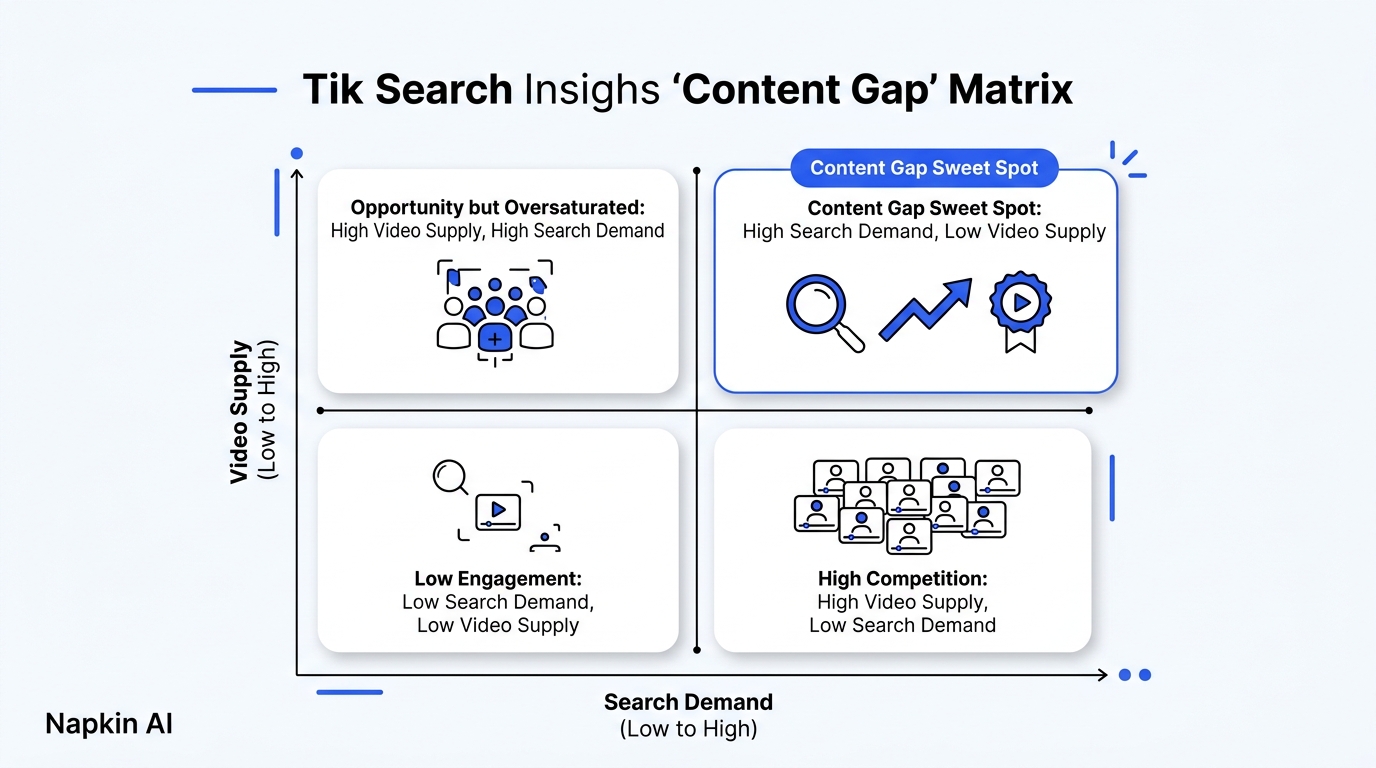
Then check TikTok's Creator Search Insights to find what your audience is actually typing. Not guessing — actual search volume data, free, inside the TikTok app. Filter by your content category. Sort by Content Gap, the queries where demand is high and video supply is low. Those are the opportunities nobody is serving yet.
Build a publishing cadence covering one search query per week. In six months, you have a library of 24 videos all indexed for specific queries. The compounding starts there.
The Shift That Already Happened
TikTok did not announce when it became a search engine. It happened as user behavior changed. Enough people found what they were looking for via TikTok that the habit formed. Now the query volume is real, the commercial intent is measurable, and competition for most search terms is still surprisingly low.
That window will close. It always does. But right now, ranking in TikTok search for a specific niche query requires significantly less optimization effort than ranking on Google for anything remotely competitive.
The creators who figure this out early build search equity that becomes very hard to dislodge. The ones who stick with pure FYP content keep chasing the viral moment.
If you want consistent, compounding, intent-driven views — start publishing for the search bar.
👉 Find what your audience is searching for with Creator Insights — audit competitor content, track trending topics, and distribute your search-optimized videos to 14 platforms automatically.