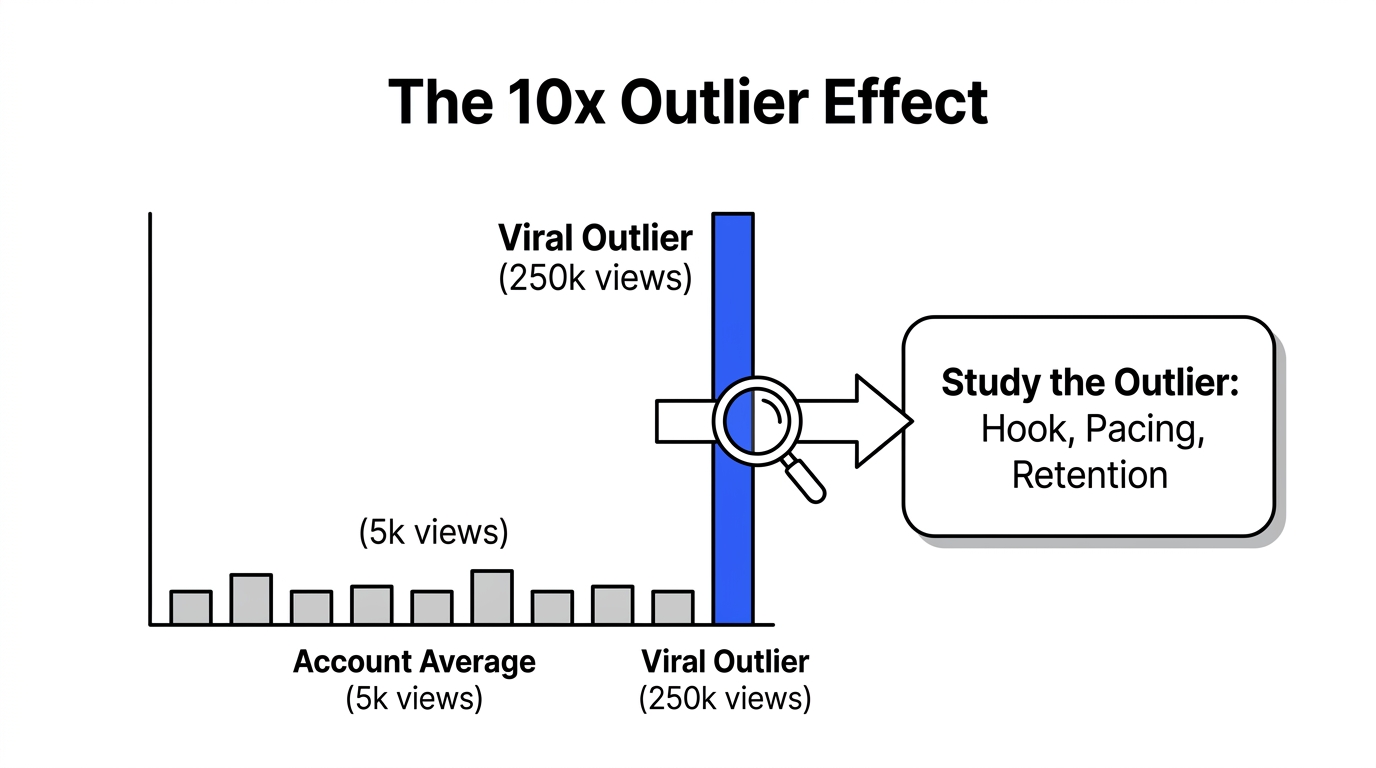
Ethically reverse-engineering competitor videos involves calculating a creator's Outlier Multiplier to isolate topics that generated five to ten times their baseline median views, deconstructing the psychological hook structure, and scripting an original video using your own examples and voice. This method validates market demand before you press record without copying intellectual property, scripts, or audio assets.
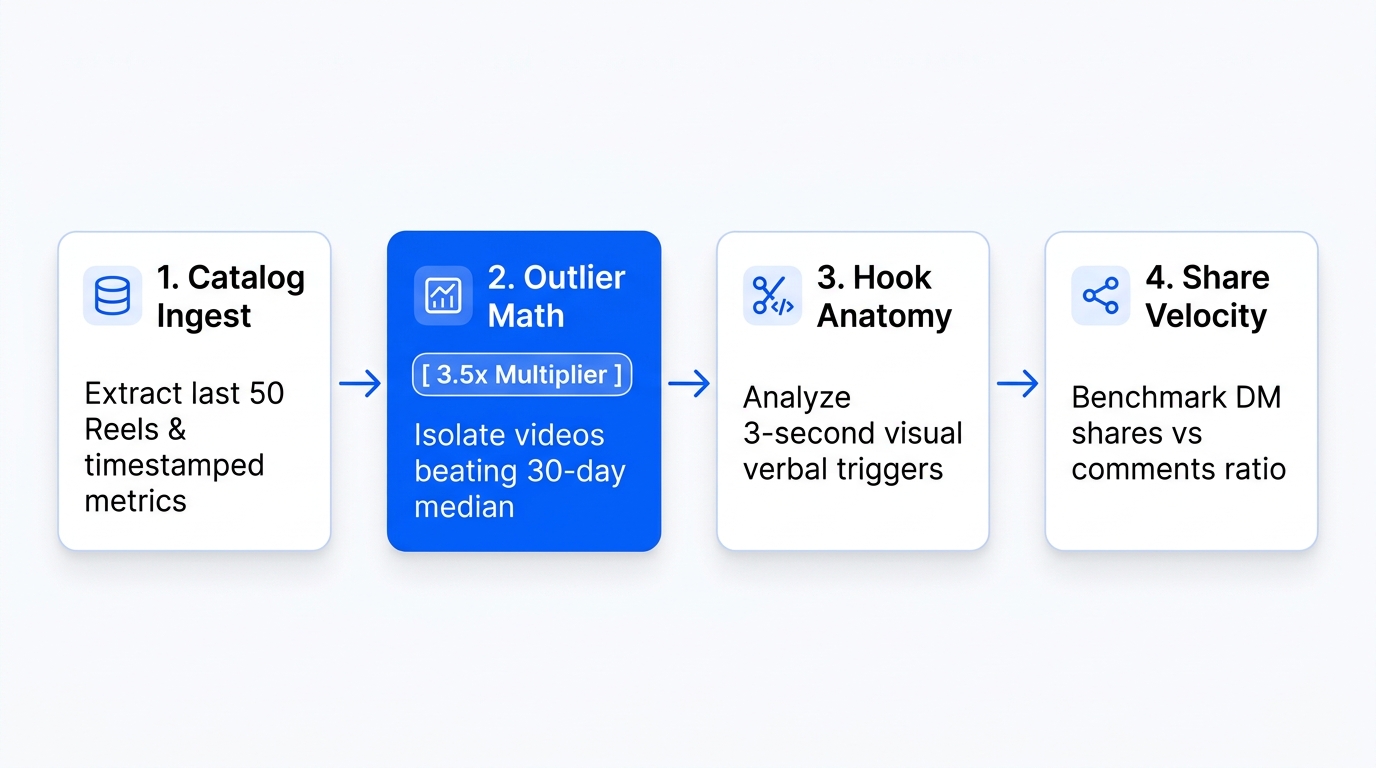
In July 2025, Rachel was spending twenty hours every week writing scripts for her personal finance channel.
She believed great creators invented everything from scratch. She sat in an empty room with a blank notebook, trying to brainstorm unique angles on budgeting, index funds, and retirement accounts.
Her results were dismal. Over forty consecutive videos, her average view count bounced between 400 and 900 views. She was burning out fast.
"I don't know what people want to watch," Rachel confessed. "It feels like throwing darts in a pitch-black room."
We introduced her to the Outlier Method.
Instead of guessing in isolation, we pulled up the top ten creators in her niche. We ignored their average videos and filtered specifically for their statistical anomalies: clips that generated at least five times their normal view counts.
One creator with 15,000 followers had posted an unassuming 45-second video about the hidden tax traps of High-Yield Savings Accounts (HYSA). The creator's typical video earned 3,000 views. This specific clip had exploded to 410,000 views.
The audience was screaming for clarity on that exact problem.
Rachel did not copy the creator's script. She did not download their video or use their voiceover. Instead, she took the underlying thesis, pulled out IRS tax forms, and filmed a breakdown using her own client case studies and whiteboard diagrams.
Her version generated 320,000 views and gained her 14,000 followers in ten days. Over the next two months, Rachel reached 52,000 followers by systematically modeling verified outlier concepts.
Sustainable creator growth comes from bringing superior clarity to problems your audience has already proven they care about.
The Outlier Multiplier Formula: Separating Luck from Validated Formats
The Outlier Multiplier calculates how many times a specific video outperformed the account's median view baseline, isolating videos that broke through algorithmic filters due to exceptional topic appeal rather than existing follower size.
                         Reel Views
Outlier Multiplier  =  ──────────────────────────────────────────
                       Median Account Views (Last 30 Days)
Looking at raw view counts is deceptive. If a creator with five million followers gets 200,000 views on a Reel, that video is actually an underperforming flop for their account size. Conversely, if an account with 2,000 followers gets 50,000 views, that video is a massive statistical outlier.
Outlier Multiplier Benchmark Scale:
• 1.0x to 1.9x: Standard baseline reach (Topic only resonates with core followers)
• 2.0x to 4.9x: Above-average resonance (Strong niche interest)
• 5.0x to 10.0x+: Algorithmic outlier (Proven universal hook with high shareability)
When you find a video with an Outlier Multiplier above 5.0x, the algorithm is telling you something vital: the topic, hook structure, and visual framing succeeded across a broad audience of cold viewers.
To automatically scan competitor profiles and calculate these multipliers without doing manual spreadsheet math, creators use the Free YouTube Viral Videos Finder.
The 4-Layer Deconstruction Blueprint
Once you identify an outlier video, dissect its anatomy across four distinct psychological layers before writing your own script.
[Layer 1: Visual & Spoken Hook] ──> First 2 Seconds (Pattern Interrupt & Curiosity Gap)
              │
              ▼
[Layer 2: The Pacing Bridge]     ──> Seconds 3 to 10 (Validates the Stakes / Why Care)
              │
              ▼
[Layer 3: The Core Payoff]       ──> Seconds 11 to 30 (Actionable Framework / Proof)
              │
              ▼
[Layer 4: The Sharing Trigger]   ──> Final 5 Seconds (Save for Reference / Send to Friend)
Layer 1: The Hook Archetype
Analyze why the viewer stopped scrolling within the first 1.5 seconds. Did the creator use a visual pattern interrupt (dropping an object, writing on glass)? Did they challenge conventional wisdom?
Identify the core question opened in the viewer's mind. Your goal is to understand the curiosity mechanism, not copy the specific wording.
Layer 2: The Pacing Bridge
Watch how the creator transitions from the hook into the explanation. Most amateur creators slow down immediately after the hook, causing retention to crater.
Outlier creators maintain momentum by cutting between different camera angles or changing text overlays every 2.5 seconds to keep the viewer's eyes engaged.
Layer 3: The Information Payoff
Identify the concrete insight delivered in the body of the video. Is the advice genuinely practical, or is it generic fluff?
If the competitor provided superficial bullet points, your opportunity is to take the same concept and deliver deeper tactical depth.
Layer 4: The Audience Objection Goldmine
Scroll directly to the competitor's comment section. Look for viewers saying:
- "I tried this and it didn't work because..."
- "What about people who live in Canada?"
- "Can you explain how this applies to beginners?"
Those questions represent the missing pieces the original video failed to answer. Build your video specifically addressing those audience objections. You can run competitor URLs through the Free Comment Analyzer to extract these patterns in minutes.
Comparison: Blatant Copying vs. Ethical Outlier Modeling
There is a clear legal and ethical boundary between intellectual property theft and intelligent market modeling.
| Action / Element | Unethical Copying (Plagiarism) | Ethical Outlier Modeling (Smart Strategy) |
|---|---|---|
| Script & Words | Paraphrasing sentences word-for-word | Writing an original script using your own voice |
| Visual Assets | Re-uploading competitor footage or audio | Shooting original b-roll, graphics, and demonstrations |
| Core Thesis | Pretending the idea was completely yours | Adding unique case studies and acknowledging context |
| Topic Selection | Blindly mimicking random personal vlogs | Validating market demand with mathematical data |
| Audience Value | Providing identical surface-level points | Answering unanswered questions from comments |
| Platform Health | Risk of copyright strikes and shadowbans | Clean algorithmic distribution and loyal followers |
Step-by-Step Workflow to Turn Competitor Outliers into Original Viral Posts
Follow this execution loop every Monday to build an editorial calendar backed by mathematical proof:
- Build a Competitor Watchlist: Identify fifteen accounts in your vertical who regularly produce short-form video. Include both large industry leaders (100k+ followers) and fast-growing small channels (2k to 15k followers).
- Filter for 5x Outliers: Isolate videos published in the last ninety days that achieved at least five times the creator's median view count.
- Extract the Core Thesis: Summarize the video's underlying premise in a single sentence: "People are overpaying for X because they misunderstand rule Y."
- Script from Your Own Experience: Answer that same core problem using your proprietary tools, personal mistakes, or client examples.
- Audit Your Profile and Cross-Post: Once your original take is produced, audit your account health using the Social Media Profile Audit on Creator Insights and publish across TikTok, Shorts, and Reels simultaneously using the Multi-Platform Distribution Tool.
Frequently Asked Questions About Competitor Video Research
Is it legal to make a video on the same topic as a competitor?
Yes. Ideas, concepts, and factual topics cannot be copyrighted under intellectual property law. Only specific expressions (such as written scripts, recorded audio tracks, and edited video footage) receive copyright protection. As long as you write your own script, shoot your own footage, and record your own audio, modeling proven industry topics is completely legal and standard practice across media.
What is the fastest way to calculate an account's median view baseline?
Take the view counts of the creator's last twenty regular uploads (excluding outliers), sort them numerically, and identify the middle value. Videos that generate five times this median number represent true algorithmic outliers.
Why do small accounts often have better outlier ideas to model than giant accounts?
When a creator with two million followers gets views, much of that reach is propelled by existing brand recognition and passive follower feeds. When an account with 3,000 followers hits 500,000 views, the video succeeded purely on the strength of its hook, retention math, and topic demand. Studying small-channel outliers gives you cleaner signals.
Will viewers notice that my video covers the same topic as another creator?
Viewers follow you for your perspective, communication style, and examples. If twenty personal trainers explain how to do a barbell squat, audiences will follow the trainer whose explanation clicks with their learning style. As long as your script and examples are original, viewers appreciate clear solutions.
How can I track competitor analytics and viral trends from one dashboard?
Creators and marketing teams use the Creator Insights Platform to monitor competitor accounts, track engagement baselines, and discover viral formats without manual scrolling, complemented by free standalone utilities in the Free Tools Suite.