Three years ago, I watched a creator in my niche explode from 8,000 to 140,000 followers in ninety days.
I was furious.
I had been posting daily tutorials for a year, carefully editing my audio in Audacity, color-correcting every frame, and answering every comment. He was filming videos on an iPhone while walking down the street with earbud microphones. Yet his Reels routinely cleared 200,000 views while mine struggled to hit 1,500.
My immediate emotional reaction was to claim the algorithm was rigged.
Then I swallowed my pride, grabbed a notebook, and actually studied his feed for an entire afternoon.
What I found humbled me. He wasn't getting views by accident or luck. He was executing a masterclass in hook structure and visual curiosity. He understood what our shared audience cared about ten times better than I did.
Once I broke down his videos into individual mechanical parts—the first sentence hook, the pacing of the cuts, the emotional payoff—I rebuilt my own production process. Within two months, my average view count jumped 6x.
Here is the exact 15-minute competitor analysis framework you can use to deconstruct any creator account without copying them or being an unoriginal clone.
Copying vs. Reverse-Engineering: Where Most Creators Fail
Let's get one thing straight right away: Copying scripts word-for-word is pathetic and doesn't work.
Audiences have incredible radar for phonies. If you take someone else's viral video and recite their words line by line, you look like a cheap knockoff. More importantly, the algorithm penalizes identical transcripts when multiple accounts syndicate the same text.
Reverse-engineering is completely different.
Reverse-engineering means extracting the underlying psychological tension and format mechanics that caused people to stop scrolling, and applying that structure to your own unique insights and lived experiences.
| Dimension | The Lazy Copycat (Fails) | The Content Engineer (Wins) |
|---|---|---|
| Hook Strategy | Copies the exact sentence and phrasing | Isolates the psychological trigger (fear, curiosity, status, loss) and writes a new hook |
| Topic Selection | Re-films the exact same tutorial from yesterday | Finds the question commenters are asking under the competitor's video and answers it better |
| Visual Delivery | Copies the same background and gestures | Uses an entirely different visual medium (screen recording, whiteboard, hands-on physical demo) |
| Long-Term Impact | Audience brands them an unoriginal plagiarist | Builds independent authority and outranks the original creator |
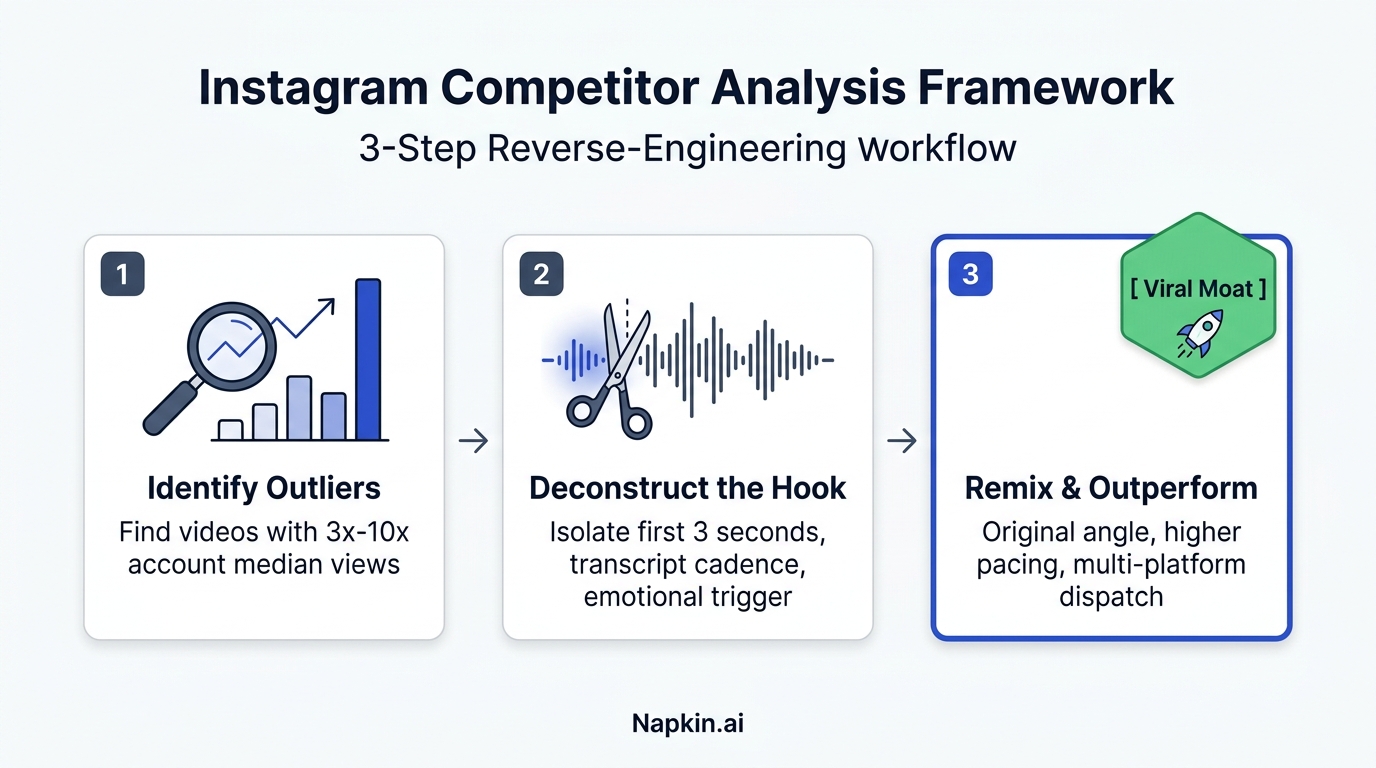
Step 1: Filter Out The Baseline Noise (The Outlier Scan)
Do not waste your time analyzing every post your competitors publish.
Most creators publish a lot of duds. If a creator with 100,000 followers posts a video that gets 12,000 views, that video tells you almost nothing useful. It's baseline churn.
You only care about statistical outliers: the videos that pulled 3x to 10x their normal view count.
Here is the manual audit math:
- Open your competitor's Reels tab.
- Scan the last 30 videos and find their typical view count (e.g., 25,000 views).
- Hunt for the anomalies: any clip that broke 150,000+ views.
- Bookmark those outlier URLs into a swipe file.
If you don't want to spend forty minutes manually scrolling on a tiny phone screen, you can run a one-click scan with our Competitor Analysis Tool to instantly sort any account's library by outlier multiplier.
Step 2: The Three-Second Hook Extraction
Once you have three outlier videos from your competitor, transcribe the first 5 to 7 seconds of audio word for word.
Look at the structure of their opening line:
Competitor's Original Hook:
"Stop using Notion for your agency clients in 2026. Here is why it is costing you $5k a month."

The Underlying Formula:
[ Contradict standard tool ] + [ Target specific buyer ] + [ Name high-stakes financial cost ]
Now, remix that formula for your own expertise without mentioning Notion or agency clients:
Your Remixed Hooks:
1. "Stop using Figma to pitch dev clients in 2026. Here is why you lose half your deals before the second call."
2. "Stop using Google Docs for brand proposals. It makes your $10k retainer look like a high school homework assignment."
Notice what happened here:
- You didn't copy their words.
- You didn't steal their work.
- You adopted a proven high-retention premise structure and filled it with your own genuine expertise.
Step 3: Mine The Comment Section for Content Gaps
The comment section beneath a competitor's viral video is the most valuable market research asset on the internet.
When a Reel gets 500,000 views, thousands of people leave comments. While 80% are simple reaction emojis, 20% are frustrated questions, objections, and confusion:
"Wait, does this work if I am on Windows 11?"
"What if I don't have a team to help manage this?"
"Is there a free open-source alternative for beginners?"
Those questions are gold.
The original creator rarely has time to go back and film follow-up answers for every commenter. That is your opening.
Grab that exact question from the comments. Make it the hook of your next video:
"Someone asked on a viral Reel last week if this workflow actually functions on Windows 11 without crashing. I tested it yesterday, and here are the three workarounds you need to know."
You just hijacked the interest generated by a half-million view video and positioned yourself as the practitioner who actually provides thorough solutions.
Step 4: Track 5 Competitors on a Weekly Cadence
Don't do competitor research once a year and forget about it. Formats shift fast on social platforms.
Pick 5 active creators in your niche:
- 2 large category leaders (500k+ followers) to spot macro format shifts.
- 2 fast-growing peers (30k to 100k followers) who are aggressively innovating hooks.
- 1 underdog newcomer (under 10k followers) who recently had a massive breakout video.
Run an audit on them every other Friday. Keep track of what angles are heating up in your industry and adapt them before the trends become oversaturated.
Ready to automate your competitor intelligence pipeline? Check out our Instagram Analyzer Engine to inspect profile growth velocities, outlier clips, and engagement benchmarks in seconds.